Rocket Learning × Google.org Fellowship
Designing Appu — a voice-first, GenAI tutor for 3–6 year-olds. I led a 0→1 design sprint that translated early childhood pedagogy, India field realities, and model capabilities into a product piloted at scale.
How I led a 0→1 design sprint to shape a voice-first, AI-powered learning experience for 3–6 year-olds across India.
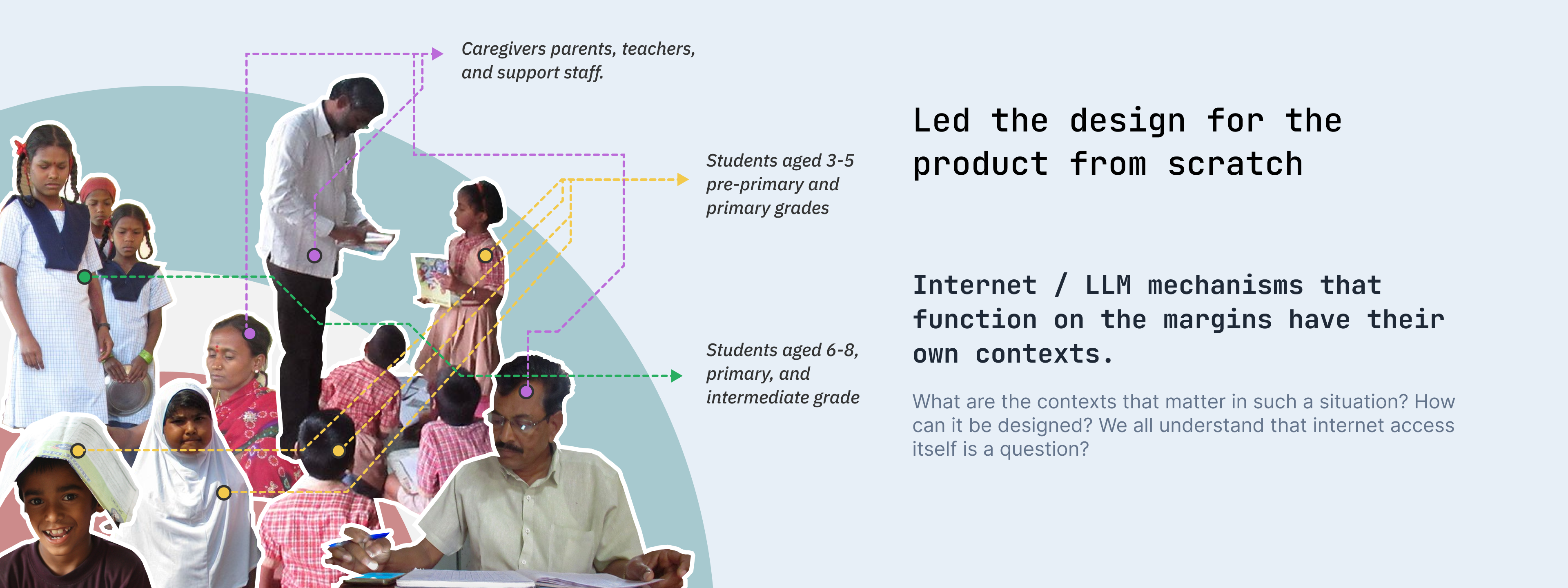
My work helped:
- Define core interaction patterns for conversational learning
- Bridge AI capability, child behaviour, and caregiver context
- Shape a product that is now piloted at scale across underserved communities
Problem / context
India faces a large early education access gap:
- Many children still lack consistent access to quality preschool experiences
- A large share of brain development occurs before age five — small windows matter disproportionately
- A lot of EdTech stays linear, screen-heavy, and weakly adaptive — a poor fit for how young children actually learn
Rocket Learning already operates at multi-million-child scale across many states. The strategic bet was clear: use new generative AI affordances to move beyond one-size content — toward adaptive, conversational learning that could still be governed by developmental science.
How the program came together
With support from Google.org:
- A material philanthropic grant plus a structured fellowship created room for rapid, responsible innovation
- Generative AI made it realistic to pursue non-linear learning paths, multilingual voice interaction, and personalisation at a cost structure that could matter at population scale
That combination led to Appu — a conversational AI tutor aimed at children roughly 3–6 years old, delivered through patterns families could actually sustain in real homes.
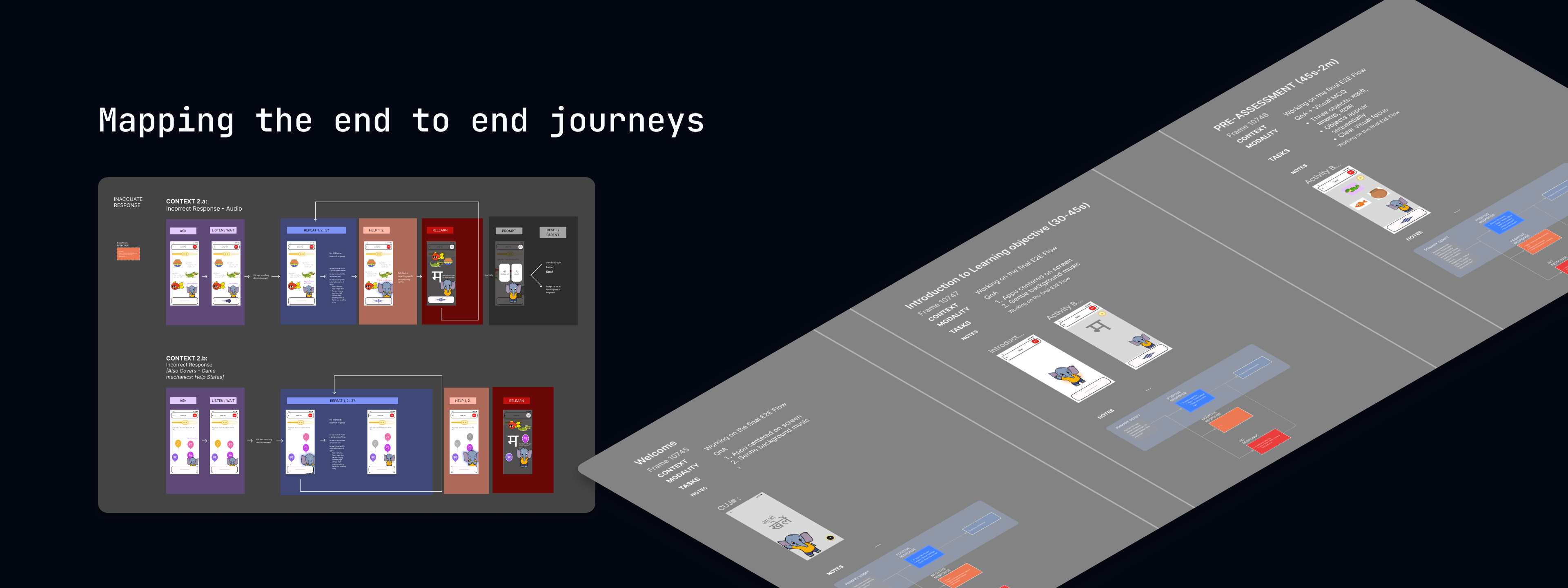
What I worked on
1. Defining the core experience (information architecture, reframed)
Early on, it was tempting to reach for a familiar “app shell” mental model: navigation regions, deep page stacks, and an object model spelled out as lesson → unit → sub-unit, with explicit transitions and success states at every layer.
For 3–6 year olds, that instinct does not survive contact with reality. Attention is fragile; the primary “competitor” is often passive entertainment (think sing-along video culture) — not another literacy SKU. Every extra layer of hierarchy was another chance to lose the child before learning started.
So we collapsed vertical depth:
- We reduced stacked page states and leaned into a flatter structure
- We shifted the experience so that progress is driven by conversation, not by navigation chrome
- Sessions were shaped as short, guided voice windows (roughly a couple of minutes), not long “sits” at a screen
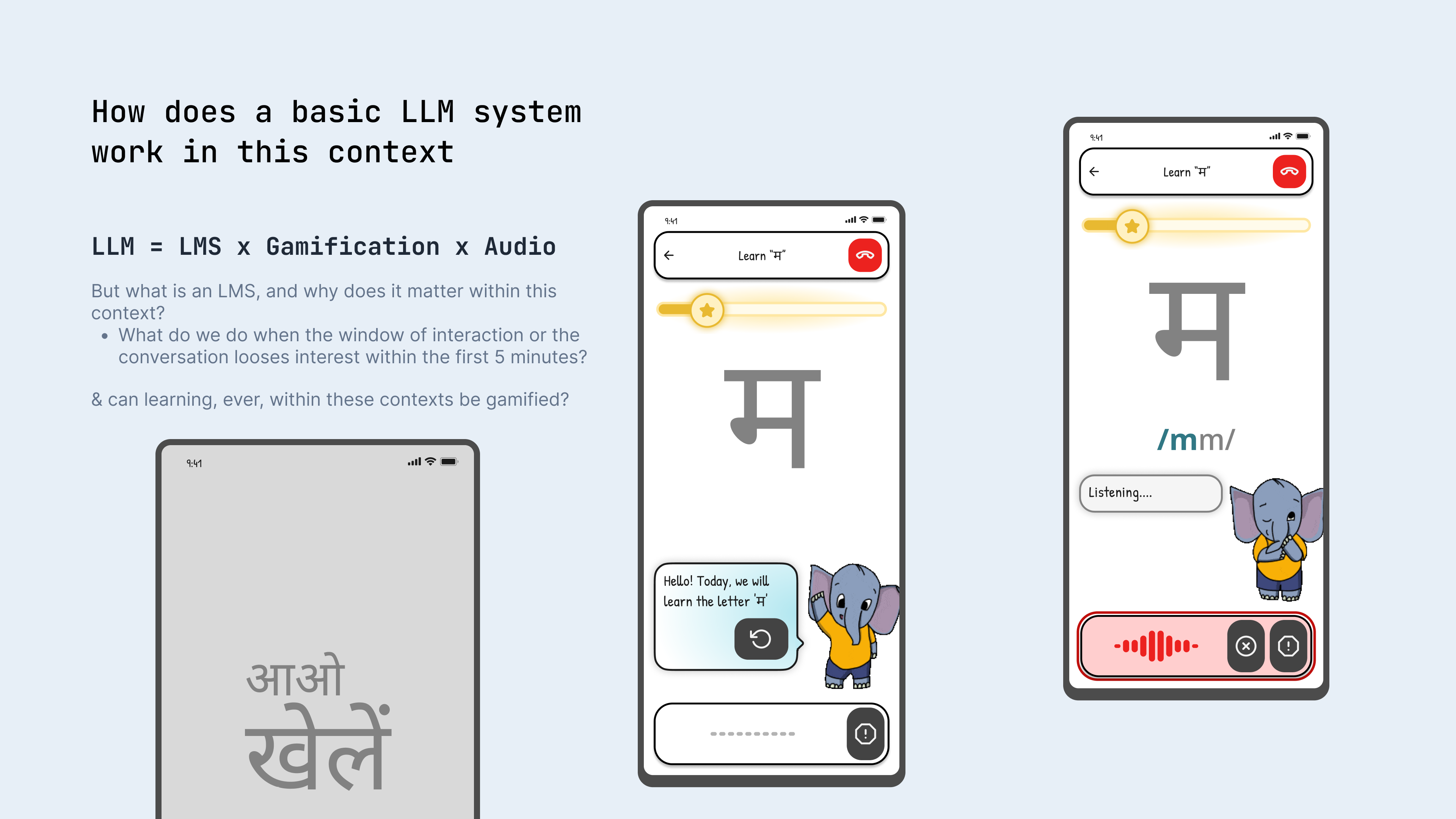
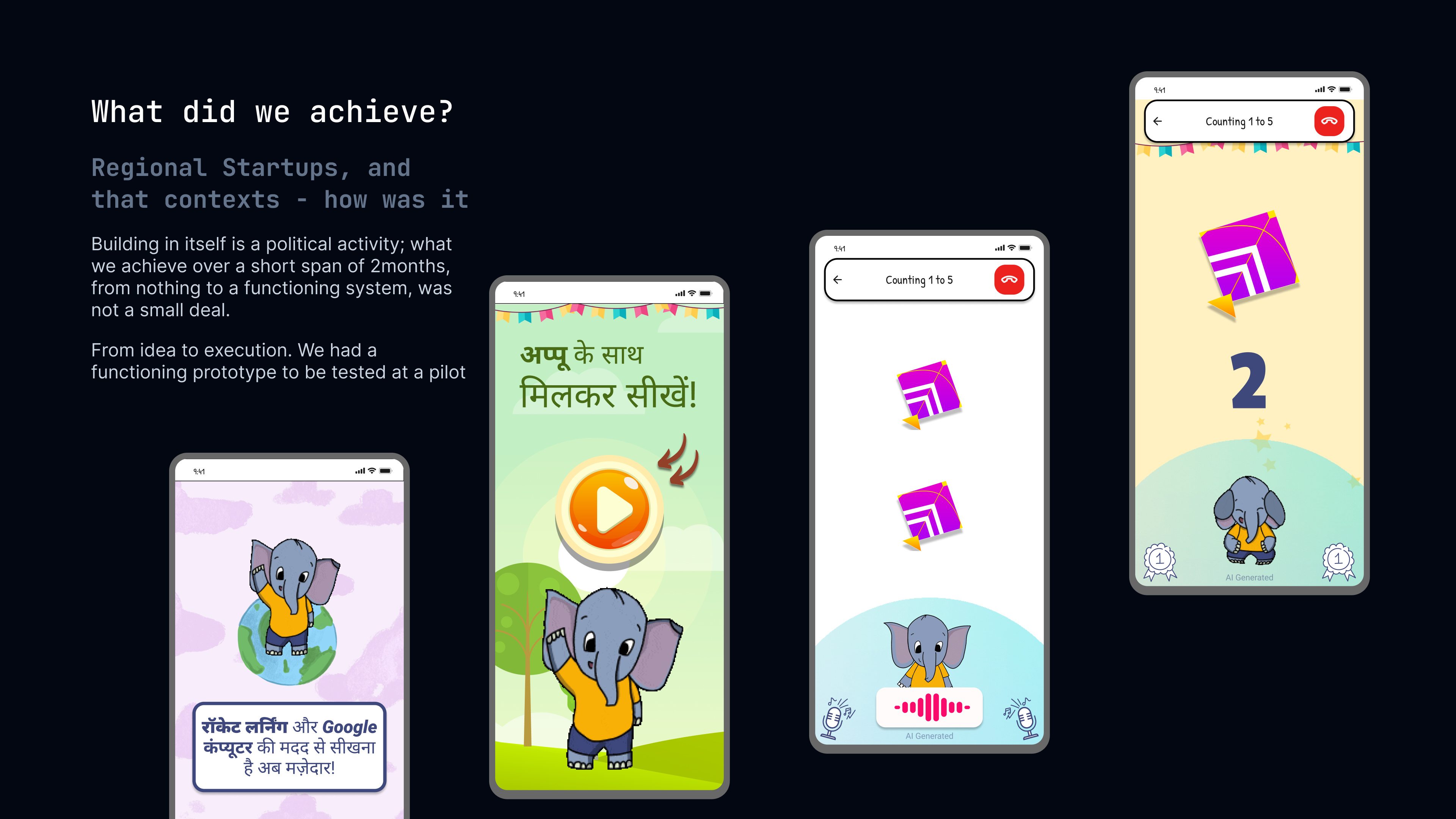
Appu is introduced as a friendly elephant tutor — voice-led, so the child meets a character first, not a dashboard.
2. Translating pedagogy into AI behaviour
We studied how teachers and caregivers explain concepts in the wild — including tiny teaching moves (for example, how “M” is anchored to “Mango” in speech and gesture, not only as a letterform). Pedagogy and education partners built a shared knowledge bank that grounded what “good teaching” means for each concept.
Because LLM outputs are non-deterministic, we wrapped the model in scaffolding we called Pedagogical Safety-in-the-Loop:
- Socratic scaffolding (adaptive prompts): Appu behaves less like an answer engine and more like a nudge engine — leading questions that help a child discover, not shortcuts that bypass thinking
- Pedagogical guardrails (foundational library): Responses are checked against the curriculum-aligned bank so outputs stay instructionally sound and locally relevant
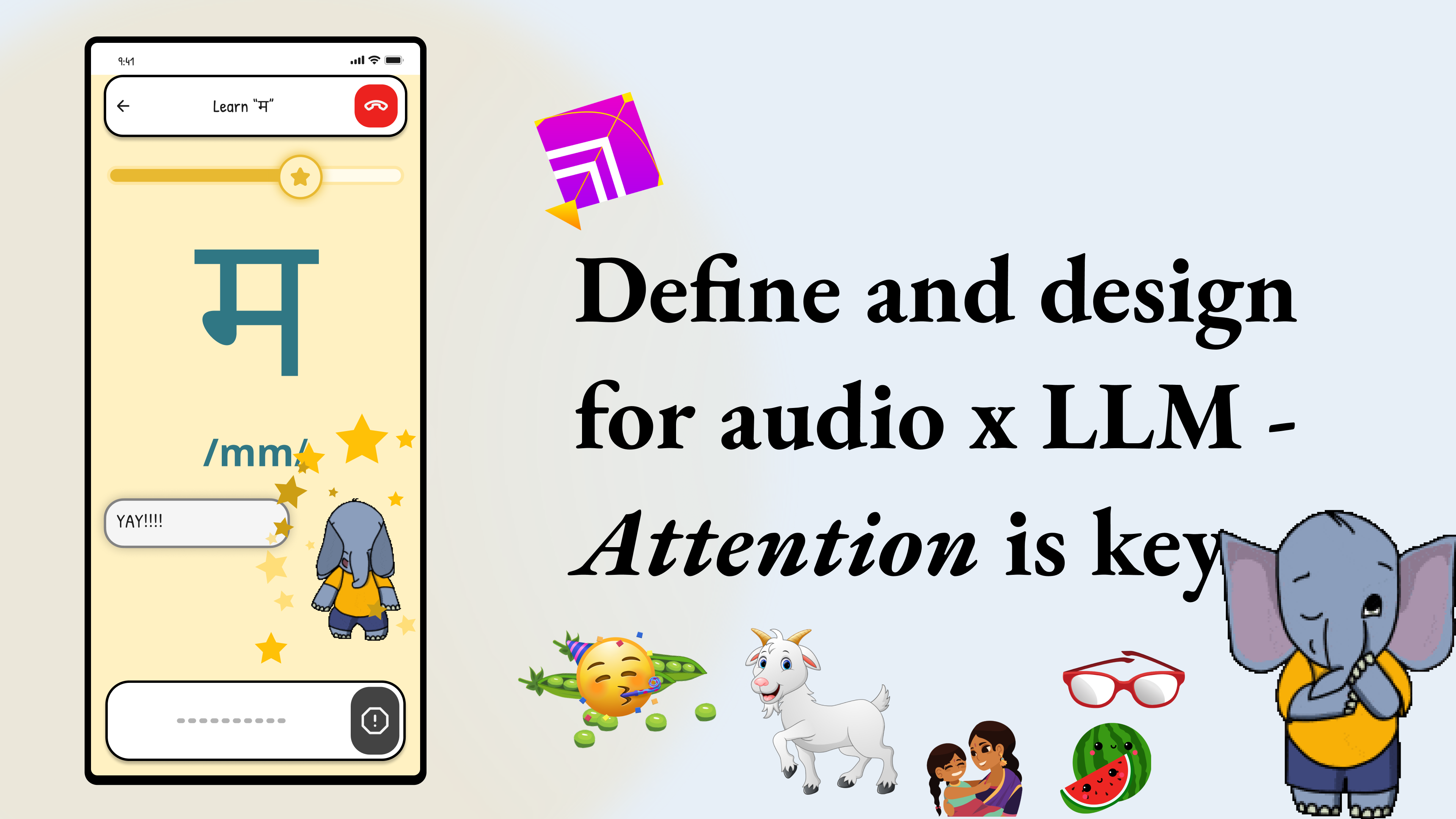
- Multi-path narrative exploration: If “M for Mango” does not land, the system can pivot — Monkey, Moon, and other sanctioned paths — based on what the child has responded to before
3. Designing for real-world India
Constraints we designed into the brief:
- Low digital literacy and uneven connectivity in many marginalized communities
- Voice-first interaction — and realistic adjacency to channels families already use (e.g. WhatsApp)
- Language as inclusion, not gatekeeping: dialect variation and code-switching are normal; “perfect” textbook Hindi or English can exclude the very learners we wanted to serve
Design responses included:
- Conversational, voice-first UX to reduce dependence on screen literacy for caregivers and children — closer to oral storytelling than to a traditional lesson player
- Multilingual tolerance (code-switching as a feature): the experience embraces natural Hinglish, Benglish, and other vernacular mixes so the product feels like a local friend, not a school examiner
- Caregiver-assisted co-learning: the flow assumes a brief shared window between a caregiver and child — prompts that help an adult stay in the loop instead of outsourcing attention to a tablet
4. AI × UX iteration loops
Generative AI plus early-childhood UX required tight loops between design, engineering, and field research. Three technical–UX problems sat at the center:
- Latency: slow first responses break conversation for a four-year-old. We pushed on time-to-first-token until the wait felt meaningfully shorter in primary flows (without publishing exact benchmarks here) and used conversational fillers (“Hmm…”, “Let me see…”) to preserve the feeling of active listening while work finished behind the scenes
- Noisy environments: rural homes are rarely silent; voice activity detection had to survive kitchens, siblings, and background life. We tuned VAD thresholds and designed explicit “listening” states so children could see when Appu could hear versus when the environment was overwhelming the mic
- Persona and safety: we used a structured pedagogical template layer so Appu stayed in character, age-appropriate, and far less likely to drift into explanations a preschooler cannot process
Early pilot signals (large regional cohort, India):
- A material lift in overall session completion versus prior static patterns
- Fewer drop-offs in the opening moments of a session — where a child decides whether this is “for them”
- Substantial voice usage logged during the initial pilot window (no exact minute counts on this page)
Impact (early signals)
- Engagement trended up versus more static content approaches
- Parents reported more confidence and verbal expression in children, and learning folding into daily routines more naturally
Rocket Learning’s north star remains ambitious: program-level goals point to national-scale reach this decade (exact targets are partner-published; I omit them here), with Appu-class experiences as one pillar of that trajectory.