Live Application Migration Planner
How I built a 0→1 product as the first designer on the platform—from early discovery through a design partner cohort, an MVP, and a strategy for productizing complex migration tooling.
Context: brownfield migration is a wicked problem
Enterprise developers were spending roughly 40% of their time navigating complex system architectures without adequate visualization tools. Brownfield application migration is inherently “wicked”: the legacy estate is incomplete, politically loaded, and still changing while you plan the move.
Industry-wide, manual discovery for enterprise migration often consumes months; automation can compress discovery to under 72 hours1. Yet about 70% of cloud migrations stall or fail when teams lack a faithful picture of the current legacy state2. Most IT budgets remain tied to brownfield maintenance3—so tooling that respects legacy reality is not a side quest; it is the main market.
Product outcome
We enabled a net-new Planner application that made brownfield enterprise migration tractable for the first time, directly addressing the large majority of customers who operate in legacy, non-greenfield environments (not the small slice on a clean-slate path).
What exists now?
Product and technical direction
- Gen AI–assisted path to deployable infrastructure: We leveraged generative AI to automate and help refactor complex brownfield enterprise applications into deployable Terraform, shrinking the gap between “what runs today” and “what we can safely express as code.”
How UX shaped product reality
- Defined shared vocabulary and system schema so engineering, field, and design could reason about the same objects and states.
- Shaped foundational architecture so the product could grow without re-litigating first principles on every milestone.
- Unlocked cross-team decision-making by making trade-offs visible early—especially where legacy constraints, risk, and sequencing conflicted.
- Co-owned frontend implementation and visualization stress-testing: I contributed directly to UI delivery, co-designing scalable components and schemas with engineering and stress-testing views against real enterprise topologies.
- Established a shared architectural and conceptual model across backend engineering, field operators, and UX so execution stayed aligned when the domain was noisy and ambiguous.
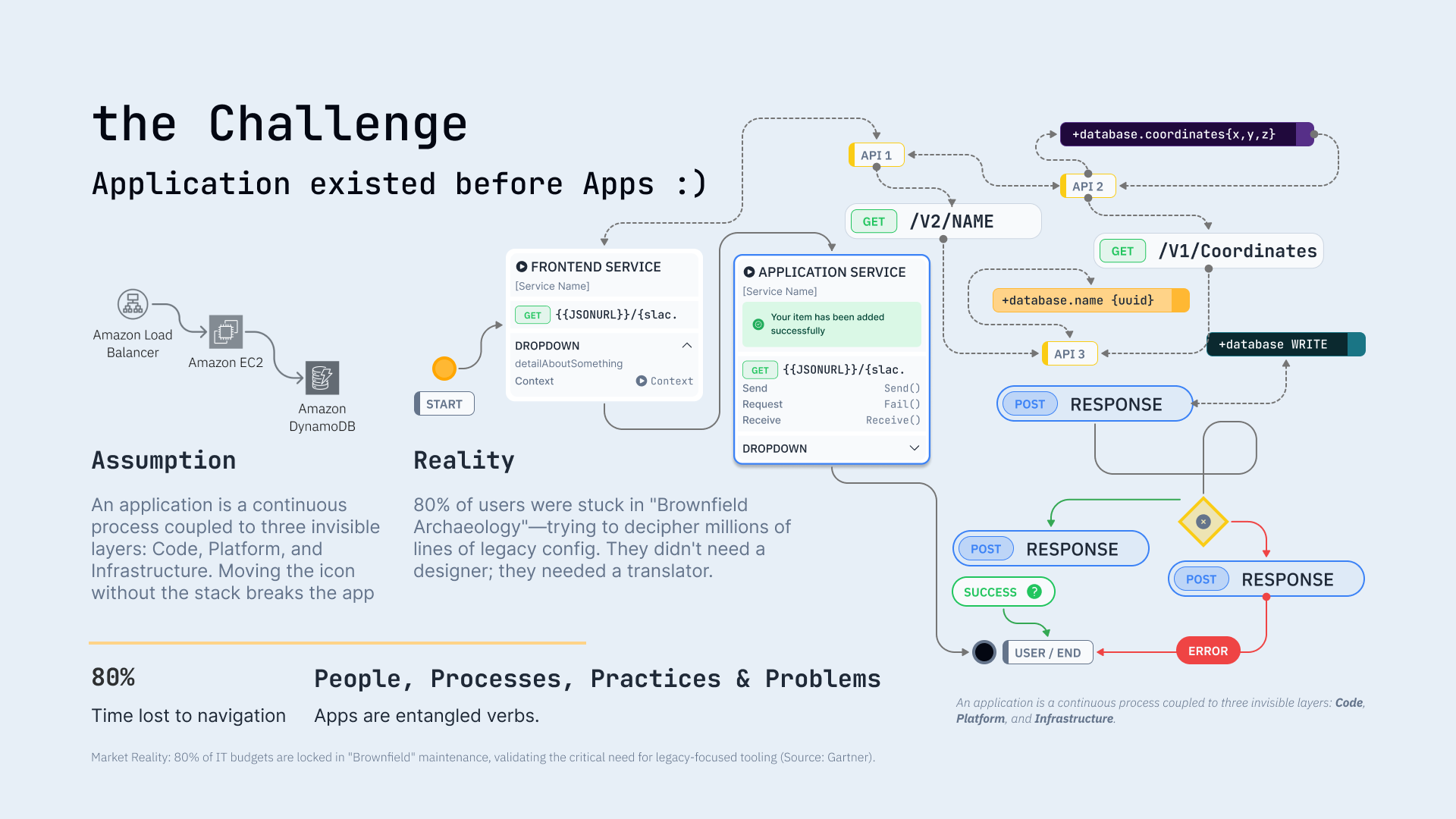
Roughly how legacy complexity shows up before you can name it: real systems rarely look like the clean diagrams in slide decks.
We delivered this capability on aggressive timelines with a lean, senior-heavy team, consistently hitting critical milestones despite high domain and technical uncertainty.
How did we solve for it?
Understanding system design
Eating the elephant
Building a shared vocabulary
Shared architectural and conceptual model
Shipping designs + systems
Heavy constraints, short timelines—also, dark mode
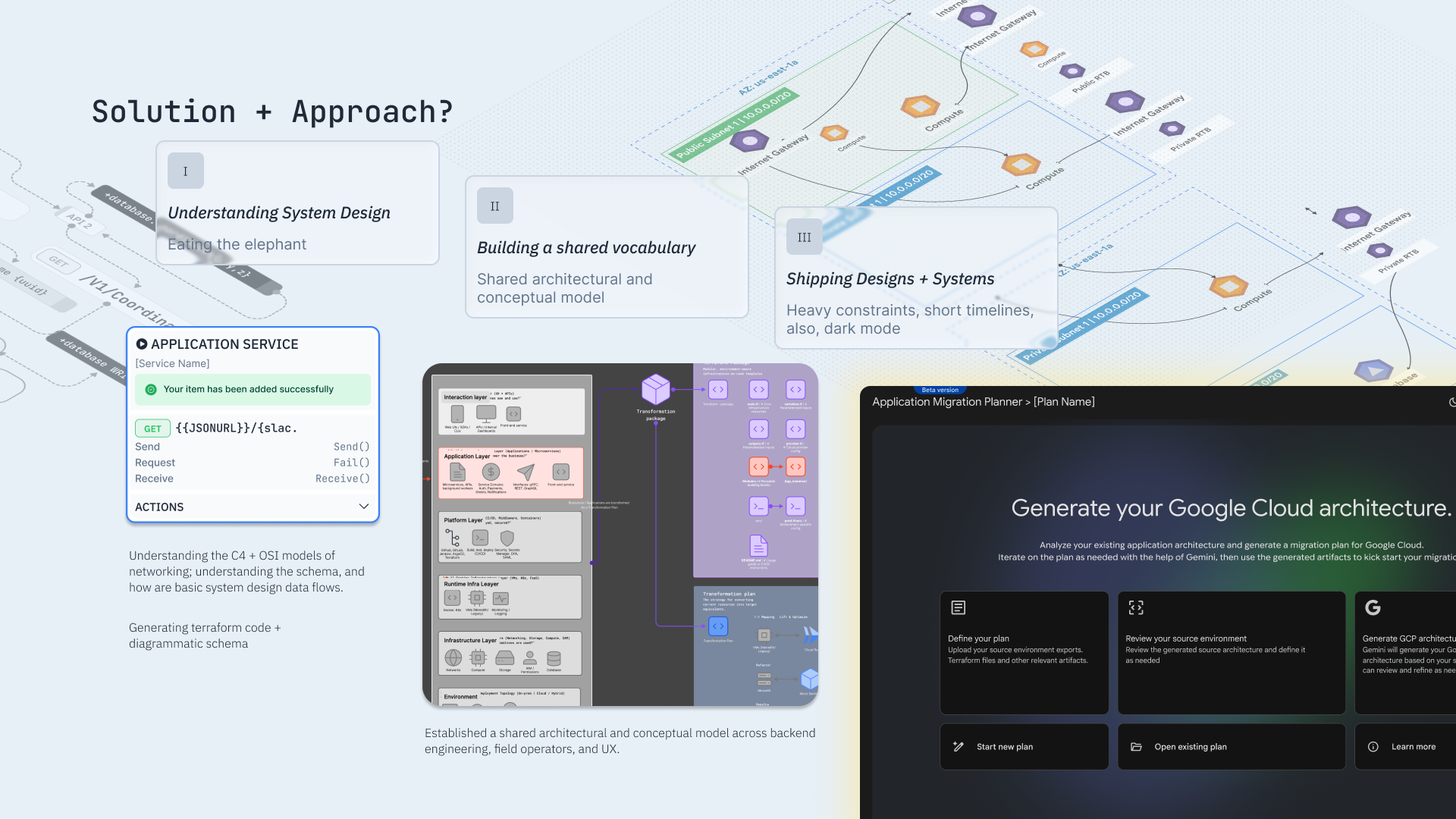
Solution & approach: from tangled legacy to something teams could execute against.
Example: trust through a side-by-side you can read
Same visual language on both sides—same box style, spacing, and arrows—so you’re not decoding two different diagrams.
Split screen: you can trace something on the left (say RDS or Route 53 on AWS) straight across to what it maps to on the right (AlloyDB, Cloud DNS on GCP). Names are just examples to show the pattern.
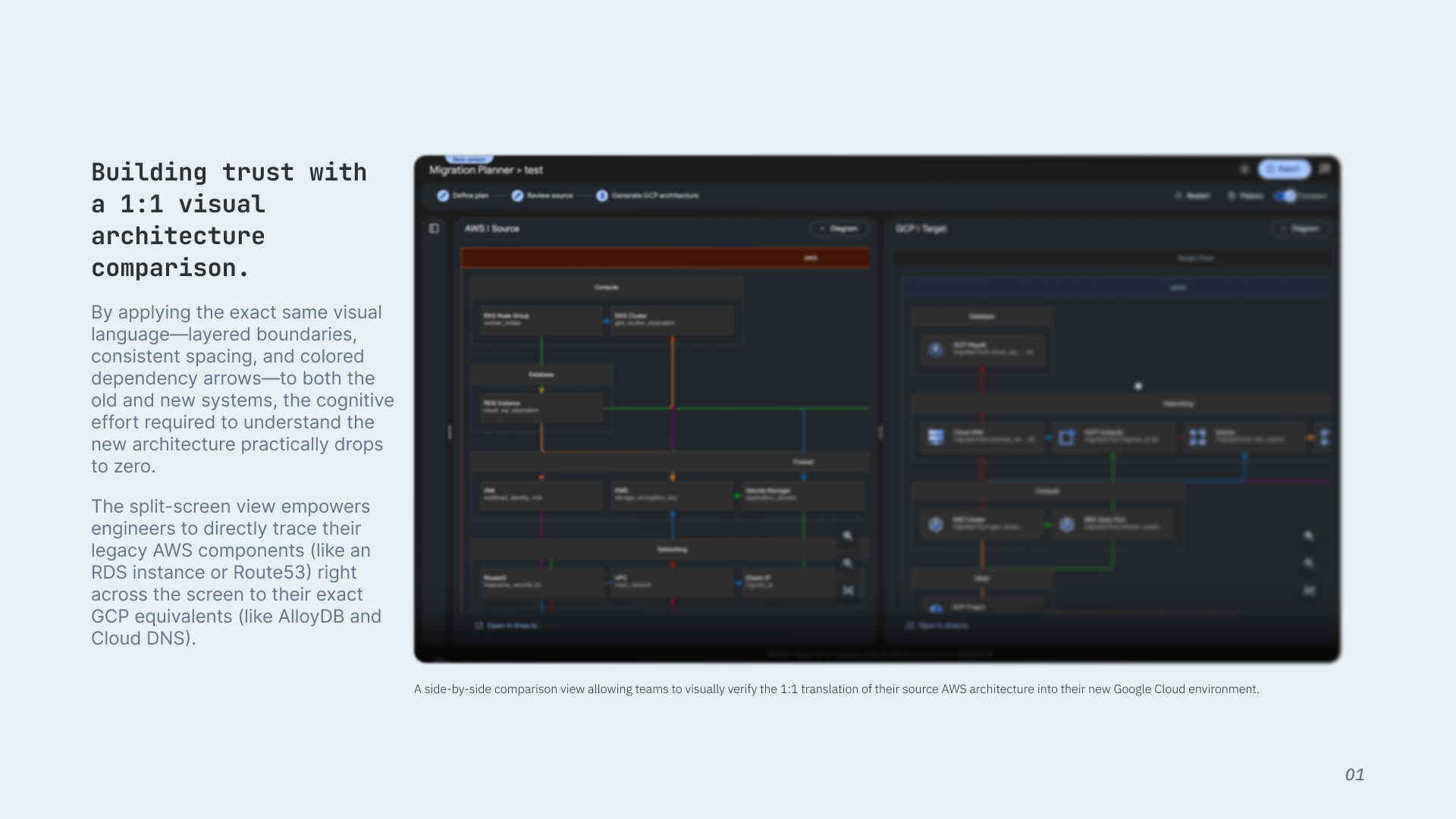
The slide looks easy. It isn’t. The hard part is everything around the picture—messy data, edge cases, people, time.
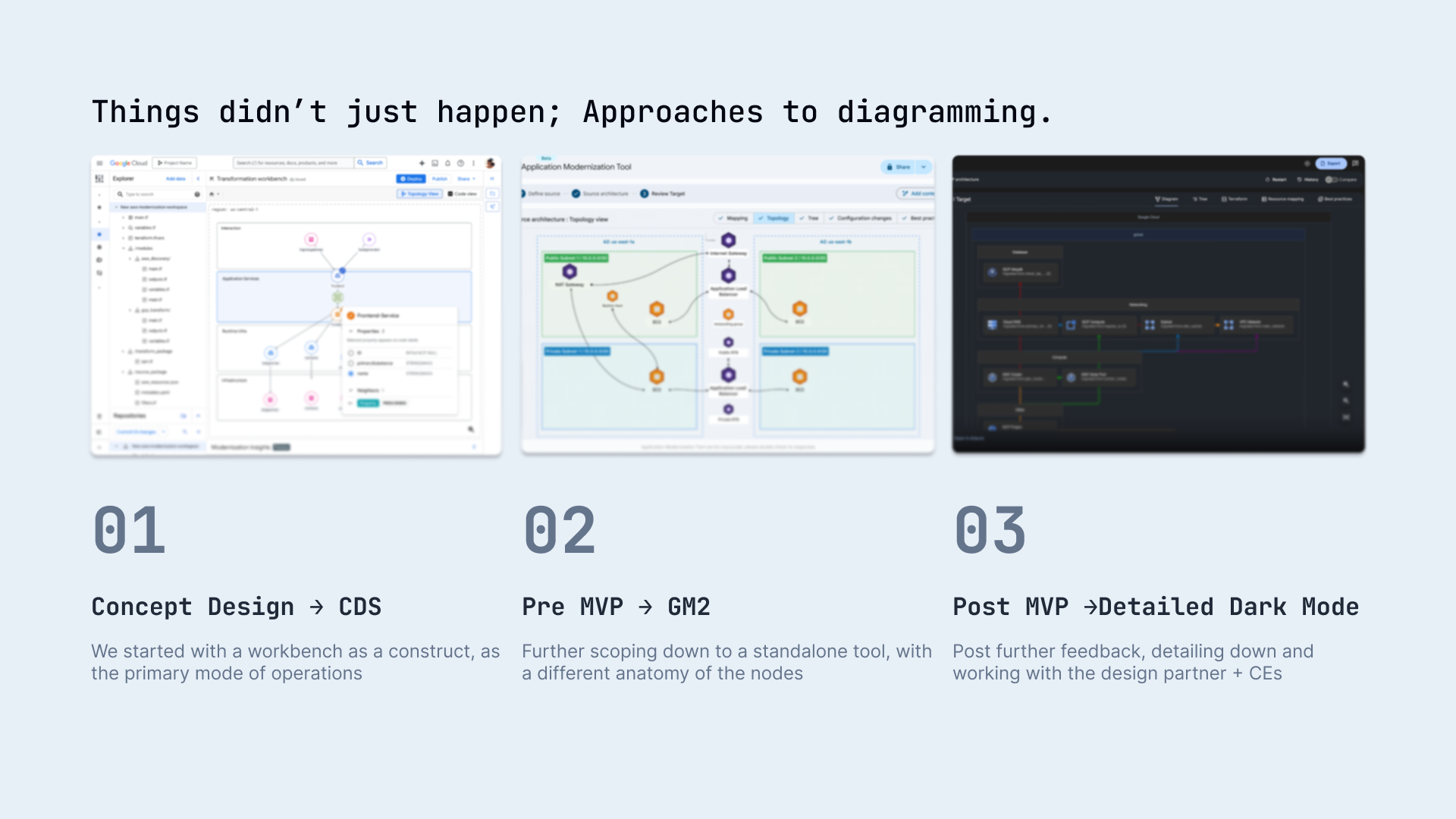
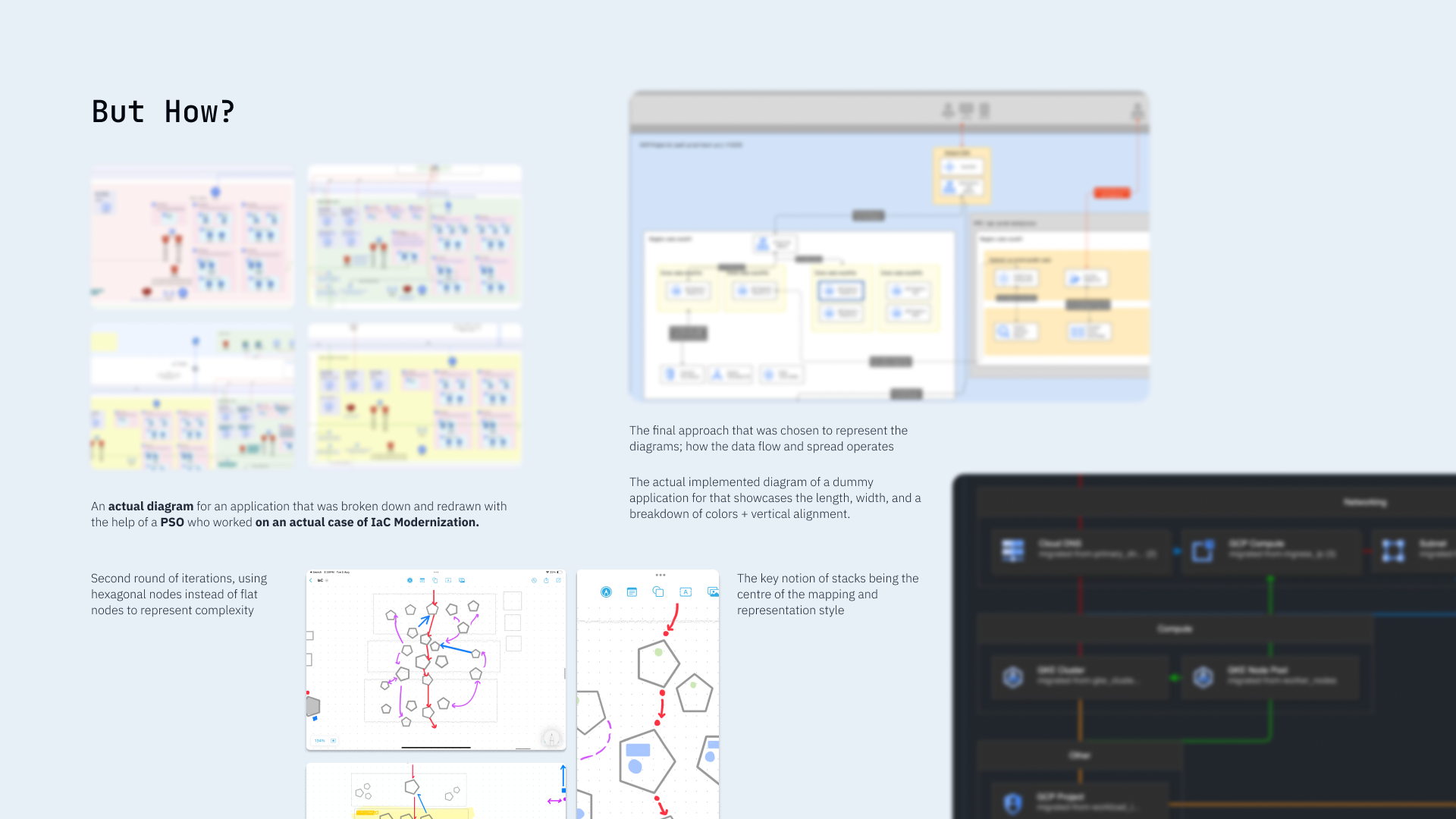
More mock explorations—same “how,” different slices of the problem.
Impact
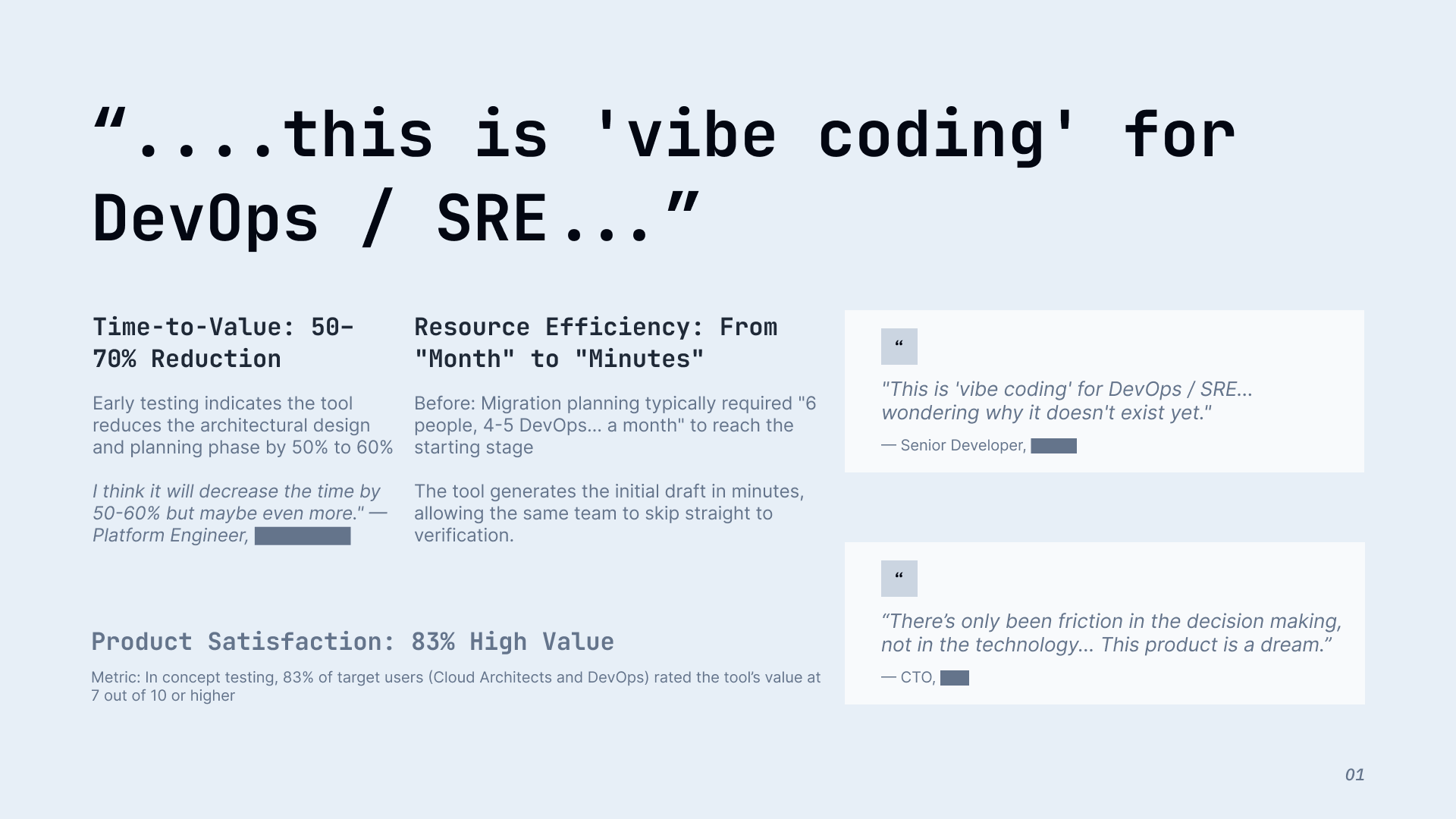
In practice, the Planner work shortened the distance between “we think we know the estate” and “we can commit to a plan”—for design partners, that showed up as fewer review cycles, clearer handoffs to engineering, and migration conversations that stayed grounded in evidence instead of slides.
Industry context: Manual discovery for enterprise migration typically consumes 3–6 months; automation can reduce this to under 72 hours. Source: AWS / CloudSphere. ↩︎
Problem scope: Roughly 70% of cloud migrations stall or fail due to incomplete understanding of the current legacy estate. Source: McKinsey / EPI-USE. ↩︎
Market reality: About 80% of IT budgets are locked in brownfield maintenance, which validates the need for legacy-focused tooling. Source: Gartner. ↩︎